Single Cell Proteins (SCPs): Overlooked Protein Alternatives
There has been a lot of discussion on the topic of meat alternatives, especially since the European ban on various meat names for plant-based products [1]. It is a very polarizing topic, and yet, there is a part of the story that is rarely covered when talking about meat alternatives: single-cell proteins (SCPs).
What are SCPs?
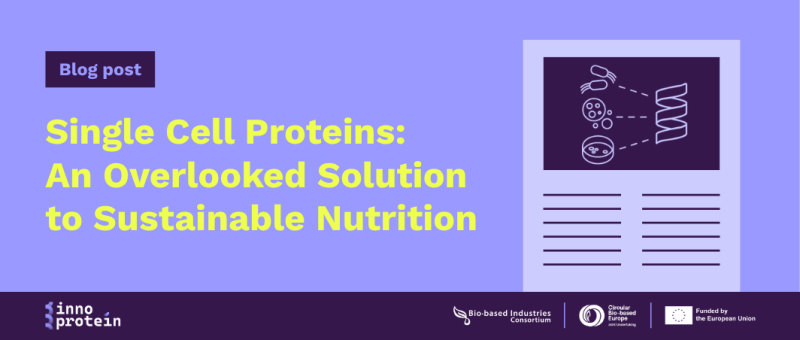
Even though SCPs seem to be a key alternative protein source, many people might not have the term before. SCPs are proteins that are derived from various microorganisms, such as fungi, yeasts, algae and bacteria, which are single-cell organisms, as the name SCP explains [2]. The SCPs refer to the final protein product that is extracted from these microorganisms [3]. The InnoProtein project focuses on fungi, algae, and bacteria as the main source for producing SCPs. As the project progresses, scientists will examine how to create the best cultivation and recovery processes to get the most out of these microorganisms. In its essence, the microorganisms are fed, left to grow and are then dried out and processed into powder or flakes [4]. These products can then be used as protein supplements, added to food products, or animal feed [4].
SCPs are an especially interesting avenue to explore, as they have a very balanced nutritional profile. They contain all essential amino acids that can be found in animal-based proteins, dietary fibers, and vitamins and minerals [5]. Another benefit of SCPs is that they closely resemble a meat-like texture, meaning they have sensory properties that can be similar to traditional protein sources [6] . SCPs are used in both human and animal feed [7].
Why are SCPs important?
Even though they are not yet popular among consumers, the use of SCPs over other protein alternatives has two main advantages: environmental and nutritional.
Environmental advantages of using SCPs are achieved by a reduction of land and water use. While traditional meat requires a lot of land use for both the livestock to live on and to grow the feed, resulting in deforestation and a rise in greenhouse gas emissions, producing SCPs only requires minimal land and water use [8]. Furthermore, the production of SCPs often makes use of wastewater as substrates for microorganisms to grow, adding to the environmental advantage of using less water [6]. Additionally, SCP production is highly efficient, with much lower energy use compared to traditional protein production, resulting in a lower carbon footprint [9].
Besides the environmental advantages, choosing SCPs has nutritional benefits as well. As mentioned above, SCPs contain various essential nutrients that are also found in traditional proteins such as meat [5]. This is crucial, as the main goal of SCP production is to use it as a protein substitute [5]. The most important macro and micronutrients found in SCPs are proteins, lipids, carbohydrates, β-carotenes, folic acid, vitamin B12, vitamin C, and vitamin E [10]. These nutritional contents vary depending on which microorganism is used to create the SCPs.
And did you know that SCPs have rapid growth rates? This means that their production is very quick and efficient, keeping up with the global demand for protein [11].
What are the barriers to using SCPs?
If the use of SCPs is such an innovative and efficient way to substitute traditional proteins such as meat, then why are they still so unknown to consumers? Unfortunately, there are two main barriers that need to be addressed first to make SCPs popular with the general public.
First, SCP production can be cost-effective, for example, by the re-use of wastewater [6]. However, producing SCPs is a very technological process, meaning that the initial investment and start-up costs might be high [12, 11]. Additionally, this equipment needs to be updated alongside new research and development that might be published to stay efficient and top of the game. Upscaling the production process is expensive as well [12]. And not to forget, SCPs are required to follow strict regulatory frameworks to be sure that final products are safe to consume, which also comes at a high cost [12, 11].
Second, many people are very hesitant to try new foods, especially new protein products such as meat alternatives [13]. If we want to make SCPs a viable alternative for human animal-based protein consumption, consumer preferences will need to change from favoring sources like meat and fish to their alternatives [14].
SCPs are an often-overlooked solution to reduce our animal-based protein intake. But science is clear: SCPs are nutritional and environmentally effective protein alternatives. Are you ready to try them?
References
[1] J. Rankin, „EU agrees to chop meaty names from vegetarian and vegan food products,” 5 March 2026. [Online]. Available: https://www.theguardian.com/world/2026/mar/05/eu-ban-meaty-names-vegetarian-vegan-food.
[2] L. Ye, B. Bogicevic, C. J. Bolten en C. Wittmann, „Single-cell protein: Overcoming technological and biological challenges towards improved industrialization,” Current Opinion in Biotechnology, vol. 88, 2024.
[3] P. Das en U. Sahoo, „Importance of single-cell protein (SCP) and its utilization in aquaculture,” The Fish World, vol. 1, nr. 6, 2024.
[4] InnoProtein, „About,” [Online]. Available: https://innoprotein.eu/about/. [Geopend 2026].
[5] B. C. Bratosin, S. Darjan en D. C. Vodnar, „Single cell protein: A potential substitute in human and animal nutrition,” Sustainability, vol. 13, nr. 16, 2021.
[6] M. I. Ahmad, S. Farooq, Y. L. C. Alhamoud en H. Zhang, „A review on mycoprotein: History, nutritional composition, production methods, and health benefits,” Trends in Food Science & Technology, vol. 121, pp. 14-29, 2022.
[7] S. J. F. Alves, E. B. E. Pires, M. A. d. S. Alexandre, C. C. A. d. A. Santos, J. G. P. Martin, P. H. Campelo, E. Martins en M. R. Eller, „Singe-cell proteins as alternative sources of proteins and nutrients,” Food Research International, vol. 214, 2025.
[8] P. T. Sekoai, Y. Roets-Dlamini, F. O’Brien, S. Ramchuran en V. Chunilall, „Valorization of food waste into single-cell protein: An innovative technological strategy for sustainable protein production,” Microorganisms, vol. 12, nr. 1, 2024.
[9] Z. Zhuang, G. Wan, X. Lu, L. Xie, T. Yu en H. Tang, „Metabolic engineering for single-cell protein production from renewable feedstocks and its applications,” Advanced Biotechnology, vol. 2, nr. 4, 2024.
[10] F. Finnigan, K. Mach en A. Edlin, „Mycoprotein: A healthy new protein with a low environmental impact,” in Sustainable Protein Sources (Second Edition), Elsevier, 2024, pp. 539-566.
[11] A. Institute, „Benefits and challenges of single cell protein production,” 18 November 2023. [Online]. Available: https://agriculture.institute/food-microbiology-fv/benefits-challenges-single-cell-protein-production/#benefits-of-single-cell-protein-production.
[12] L. Searby, „Single cell proteins: A question of cost,” Food Navigator Europe, 15 August 2024. [Online]. Available: https://www.foodnavigator.com/Article/2024/08/15/single-cell-proteins-a-question-of-cost/.
[13] Ç. Çınar, A. K. Karinen en J. M. Tybur, „The multidimensional nature of food neophobia,” Appetite, vol. 162, 2021.
[14] M. P. Gundupalli, S. Ansari, J. P. V. da Costa, F. Qiu, J. Anderson, M. Luckert en D. C. Bressler, „Bacterial single cell protein (BSCP): A sustainable protein source from methylobacterium species,” Trends in Food Science & Technology, vol. 147, 2024.